The service targets of the obstetrics and
gynecology department are women, mainly pregnant women. Therefore, when designing the building, a female-centered idea should be established to create a safe, warm, comfortable and convenient space environment, create a relaxed and pleasant diagnosis and treatment atmosphere, and give women safety Feeling and comfort. At the same time, the obstetrics and gynecology department is also the place where life is born. It nurtures hope every moment, protects health, and builds a safe, comfortable, and humanistic modern medical environment to ensure that patients, their families, and staff can achieve positive health in it. physical and mental feelings.
The layout and setting of the delivery room
The setting of the delivery room should be based on the principles of convenient work, conducive to the safety of mother and baby, and consistent with isolation and sterility. It should be a relatively independent area adjacent to the operating room, maternity ward, mother-infant rooming-in, and neonatal room. The layout should be reasonable and clearly divided into non-restricted areas, semi-restricted areas and restricted areas.
Areas should be separated by doors or clearly marked. A qualified hospital delivery room should have three passages, namely patient passage, staff passage and waste passage. The patient passage should be close to the delivery room, the staff passage should be close to the dressing room, and a waste passage should be set up in the delivery room so that waste can be transported directly from the outer corridor.
1. Non-restricted area
Disinfection mats should be installed at the flat car transfer areas such as shoe changing and dressing and flat car entry areas, maternity emergency rooms, hospital treatment rooms, dressing areas, bathrooms, duty stations, lounges and other non-restricted areas outside the delivery room. Disinfection mats at the door should be replaced regularly.
①Emergency and admission treatment room: equipped with desk, examination bed, fetal heartbeat monitor (should have Doppler equipment), pelvic ruler, soft ruler, sphygmomanometer, stethoscope, medical examination instrument, thermometer, weight scale, flushing Perineal disinfectant and flushing utensils, anal examination gloves, clothes, disinfected tissue, etc.
②Maternity toilet: There is a bathroom and toilet inside. The toilet is suitable for sitting on the toilet. There is a signal light in the toilet and there is a sink.
③The staff locker room, sewage treatment room, and instrument cleaning room are equivalent to the operating room. The bathroom is the same as that of the general ward.
2. Semi-restricted area
Located in the middle, it includes office (desk), maternity room, staff lounge, treatment room, utility room, linens, storage room, dressing preparation room, equipment room, washing room, warehouse, duty room, etc.
① The preparation room should be equipped with workbench, cart, equipment rack or cabinet. This room is used for instrument wiping, dressing, and instrument packaging, waiting for preparations for disinfection and sterilization.
② Delivery room: All pregnant women who have entered the first stage of labor should be sent to the delivery room. The delivery room should be close to the delivery room and office. There should not be too many beds in the room, preferably 1-3. The bedside table should be equipped with a fetal heart sound receiver, fetal heart rate monitor, sphygmomanometer, rectal examination finger cot and lubricant.
3. Restricted area
The restricted area is located at the innermost side of the delivery room, including the delivery room (divided into normal delivery room, isolation delivery room, mid-term induction room, and warm delivery room), toilets, and sterile item storage rooms.
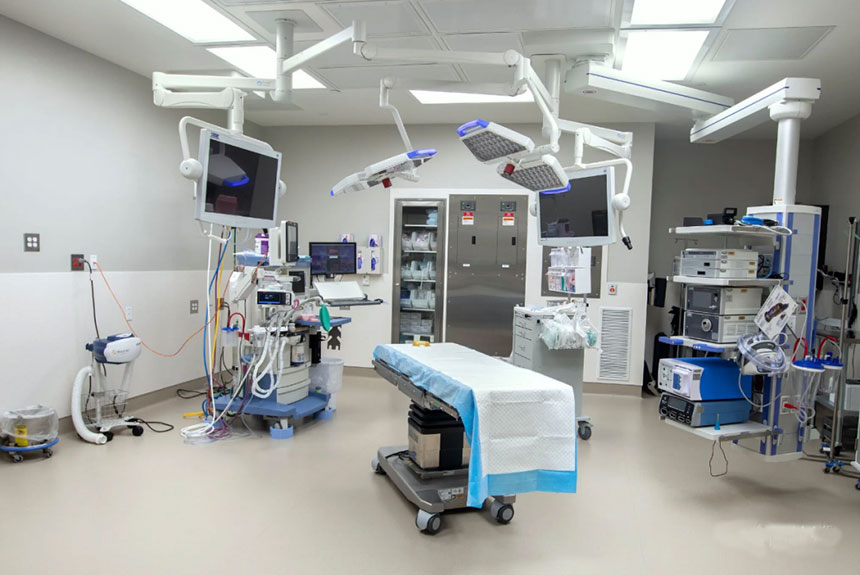
①Normal delivery room: It should be located between the neonatal room and the delivery room, and its floor and wall construction requirements are the same as those of the operating room. The ratio of delivery beds to obstetrical beds is generally 1:8-1:10. If there are many delivery beds, rooms must be divided. Equipped with sterile instrument cabinets, sterile dressing cabinets, medicine cabinets, surgical instrument tables, neonatal rescue tables, surgical lights, baby scales, oxygen equipment, electric suction machines, central suction devices, Doppler fetal heart rate monitors, and ultraviolet rays Lamps, refrigerators, etc. There should be heating, cooling or air conditioning equipment indoors. The room temperature is maintained at 24-26℃ and the relative humidity is 55~65%.
Qualified hospitals should be equipped with fetal heart rate monitors, ECG monitors, and resuscitation devices. In addition, surgical instruments, rescue equipment and first-aid drugs for dystocia should also be available.
Commonly used obstetrical dystocia surgical instruments include various types of forceps, various sizes of fetal head aspirators, scalp forceps, fetal membrane puncture needles, toothless and toothed ring forceps, large speculum, vaginal retractor, etc.
Commonly used rescue equipment: central venous pressure measuring device, venous incision bag, neonatal tracheal intubation supplies, sandbag ~1 kg), tongue forceps, gag, tongue depressor, blood transfusion set, anesthesia machine, etc. If conditions permit, a monitoring room can be set up, which is equipped with fetal heart rate monitors, neonatal monitors, pacemakers, defibrillators, rescue equipment, etc. often
Use emergency medicines: In addition to general operating room medicines, uterine contraction agents, vasopressors, antihypertensive agents, hemostatic agents, diuretics, cardiotonic agents, anesthetics, etc. should be added.
②Isolated delivery room: The equipment is simple. In addition to the above necessary conditions,
Its layout and equipment should facilitate disinfection and isolation.
It should not be located in the middle of the delivery room area. Special masks, hats, isolation gowns and shoes are provided at the entrance. Enter
There are facilities for washing hands and hand sanitizer at the entrance, and a screen door is installed. If possible, set up a laminar flow negative pressure room.
③ Washroom: Located between the delivery rooms (the two rooms are separated by glass for easy observation), it should be able to accommodate 2-3 people washing their hands at the same time. The wash basin and hand brushing equipment are the same as those in the operating room.
④ Sterilized dressing room: It is equipped with racks and cabinets to store sterilized production packages, various instruments and dressings. There is dehumidification
The floor layout should be reasonable, and the delivery room area of a hospital where conditions permit should be equipped with three passages, namely maternal passage, staff passage and waste passage. The maternal passage should be close to the delivery room, and the staff passage should be close to the dressing room. The delivery room is equipped with a waste passage so that waste can be transported directly from the outer corridor. The waste passage can also serve as a visit passage for family members. Toilets should be installed in the delivery room and the delivery room that integrates delivery and postpartum care. The usable area of the delivery room should be no less than 20m2, and the net dimensions of the delivery room should be 4.2m×4.8m.
For parturients with infectious diseases or suspected infectious diseases and those who have not been screened for blood-borne diseases, they should wait for labor in isolation and give birth in isolation. The isolation delivery room and the isolation delivery room can be used together. The isolation delivery room should be equipped with a buffer room with hand hygiene facilities. It should not be located in the middle of the delivery room area. It should be equipped with independent entrances and exits.
LDR delivery room
LDR (Labor-Delivery-Recovery) integrated delivery room is a single room that integrates labor, delivery and postpartum recovery.
LDRP is the abbreviation of Labor (labor), Delivery (production), Recovery (postpartum recovery), and P (Postpartum). It is a family delivery room that integrates labor, delivery, postpartum recovery, and rehabilitation. The unit area should not be less than 28㎡. Applicable to all labor and delivery processes except cesarean section and delivery requiring general anesthesia. There is no need for the mother to move during the delivery process, making the natural delivery process smoother and more comfortable. Since the LDR and LDRP integrated delivery rooms are accompanied by family members throughout the process, in order to avoid affecting other delivery rooms, they should be set up independently or in a relatively independent location in the delivery room area, or in a relatively independent area of the obstetric ward. An integrated delivery bed should be installed in the room to meet the needs of delivery and hospitalization. Baby bathing facilities also need to be equipped to meet baby bathing requirements.
The delivery room area should be equipped with a caesarean section operating room, and the net size of the operating room should be 5.4mX4.8m. The caesarean section operating room is used for emergency unplanned caesarean section operations, which can save valuable time, avoid patients from moving back and forth, and ensure patient privacy and safety. If there is no condition to set up a caesarean section operating room, a rapid transfer channel should be set up between the delivery room area and the operating department to ensure that the mother can reach the operating room in a short time.
Commonly used medical equipment in the delivery room
Commonly used medical equipment in the delivery room includes delivery beds (LDR is equipped with integrated delivery beds), baby radiant warming tables, gynecological examination lights, fetal monitors, etc., which can be configured according to the requirements of different delivery rooms. In addition to the conventional operating room configuration, the medical equipment in the caesarean section operating room also needs to be equipped with equipment required for delivery.