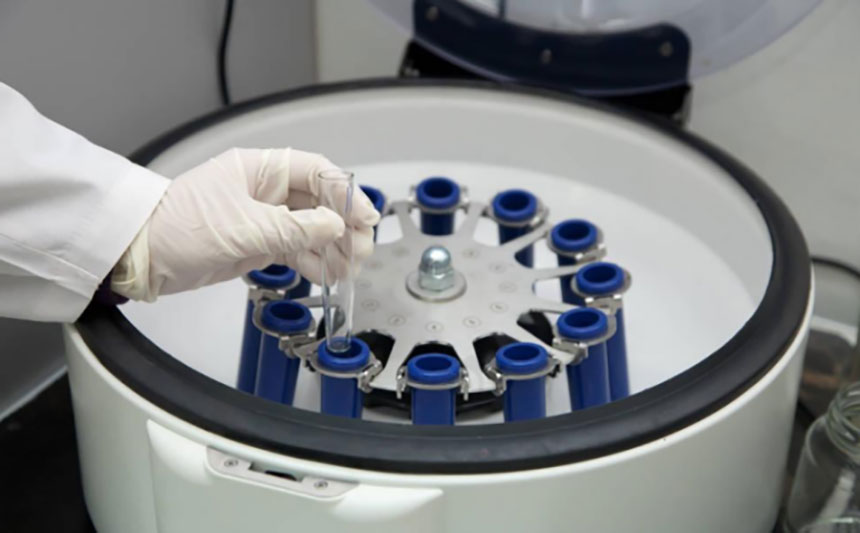
Laboratory
centrifuges have a wide range of applications and are generally used in various laboratories such as hospital laboratories, scientific research institution laboratories, food and drug inspection laboratories, and food hygiene laboratories. Today I will introduce to you how to choose centrifuge and centrifuge tube types according to experimental needs, as well as centrifuge operation precautions and safety risk prevention.
1. Classification of centrifuges
According to the structure type, it can be divided into: desktop centrifuge and vertical centrifuge (floor-standing centrifuge)
According to the separation method, it can be divided into: filter centrifuge and sedimentation centrifuge
It can be divided according to speed: low-speed centrifuge (<10000rpm/min), high-speed centrifuge (10000-30000 rpm/min), ultra-high-speed centrifuge (>30000rpm/min)
According to the capacity, it can be divided into: micro centrifuge (micro centrifuge or mini centrifuge), small capacity centrifuge, large capacity centrifuge and ultra-large capacity centrifuge
It can be divided according to whether there is refrigeration: refrigerated centrifuge and normal temperature centrifuge
In addition, they are also classified according to different uses.
2. Types of centrifuge tubes
Glass centrifuge tubes: cannot be used in high-speed and ultra-speed centrifuges, only suitable for low-speed centrifuges.
PA pipe and PP pipe: chemically stable, translucent, and able to withstand high temperature sterilization
PC tube: good transparency, high hardness, and able to withstand high temperature sterilization. But it is not resistant to strong acids, alkalis and some organic solvents. Mainly used for centrifugation above 50,000 (rev/min).
CN tube: The texture is soft and transparent, but it is not resistant to strong acids, alkalis and certain organic solvents, and cannot be sterilized by high pressure. Suitable for density gradient centrifugation such as sucrose and glycerol. Transparent and easy to collect.
Steel centrifuge tubes: high strength, non-deformation, resistant to heat, frost, and chemical corrosion, widely used, but avoid contact with highly corrosive chemicals when using them
3. Installation of centrifuge tubes
1. When using various centrifuges, all centrifuge tubes, centrifuge tube covers, hanging baskets and adapters must be precisely balanced on the balance in advance. The weight deviation during balancing shall not exceed the range specified in the centrifuge manual.
(1) Weight balance. Generally, the deviation required for precision balance should not exceed 0.1g. For routine applications, the deviation should generally not exceed 1g. The weight deviation should not exceed the range specified in the centrifuge manual.
(2) Density balance. The materials filled in the centrifuge tube must have similar densities, otherwise the load will be distributed unevenly.
(3) Try to avoid loading an odd number of centrifuge tubes in the rotor. When the rotor is only partially loaded, they should be evenly distributed so that the load is evenly distributed on the rotor body.
(4) When there are an odd number of centrifuge tubes, the balanced tube must be filled with materials of similar density. For example, when centrifuging bacteria from the culture medium, it can be balanced with water. However, water cannot be used to balance chlorine
2. When loading the solution, select a suitable centrifuge tube according to the nature and volume of the centrifuge solution and follow the specific operating instructions of the centrifuge.
3. When using a centrifuge tube without a cap, the liquid should not be filled too much to avoid being thrown out during centrifugation, causing the rotor to become unbalanced, rusty or corroded.
4. When using a cover to seal a centrifuge tube and requiring vacuuming, it is generally required that the liquid must be filled to prevent the upper part of the plastic centrifuge tube from being deformed by the air during centrifugation.
4. Selection of centrifugation method
Three commonly used centrifugation methods: differential centrifugation; rate zone centrifugation; isopycnic zone centrifugation.
1. Differential centrifugation method
Differential centrifugation is often used to extract crude products from biochemical samples. It makes use of the difference in sedimentation coefficients of different suspended particles in the centrifugal force field. Under the same centrifugal conditions, different particles have different sedimentation speeds. By continuously increasing the relative centrifugal force, a non-uniform mixed liquid is created. Particles of various sizes and shapes in the dispersion system are layered and precipitated.
During the operation, the supernatant is usually separated from the precipitate after the first stage of centrifugation, and then the supernatant is centrifuged at a higher speed to separate out the second part of the precipitate. In this way, the speed is increased step by step, and the speed is increased step by step. Separate the required substances. The resolution of differential centrifugation is not high, and various particles with sedimentation coefficients within the same order of magnitude are not easy to separate. It is often used for the extraction of crude products from biochemical samples.
2. Rate zone centrifugation
Rate zonal centrifugation is an incomplete sedimentation separation. The sedimentation effect is greatly affected by the physical scale of the material itself. It is generally used in situations where the materials are of different sizes but have the same density. It refers to the centrifugal force of the particles to be separated. Due to the different sedimentation speeds in the gradient liquid, particles with different sedimentation speeds after centrifugation are in different density gradient layers, forming several separate sample zones to achieve the purpose of separation from each other.
For example, if you want to isolate mononuclear cells from venous blood, Ficoll, the former separation solution, divides all mononuclear cells (lymphocytes and monocytes) in the blood into one layer and extracts them at the same time. The Percoll separation solution separates lymphocytes and monocytes in the blood into two gradient layers and extracts them separately. The gradient liquid acts as a supporting medium and stabilizer during the centrifugation process and when sampling after centrifugation, to avoid resuspension of stratified particles due to mechanical vibration.
When using the rate zone centrifugation method, the centrifugation time needs to be strictly controlled, not only to allow enough time for various particles to form zones in the medium gradient liquid, but also to avoid any particle to be separated from forming a precipitate state.
3. Isopycnic zone centrifugation
Isodensity zone centrifugation means that when there is a buoyancy density difference between different particles in a liquid dispersion system, under the centrifugal force field, the particles either sink downwards or float upwards, and move along the gradient to a position where their densities are exactly equal, that is, equal density. Density point, centrifugal method of forming zones.
The centrifugal effect of isopycnic zone centrifugation depends on the buoyancy density difference of the particles. The greater the density difference, the better the separation effect, regardless of the size and shape of the particles, but the latter two determine the rate, time and zone of reaching equilibrium. width.
Characteristics of the isopycnic zone centrifugation method:
(1) Related to the density of sample particles;
(2) Independent of the size of sample particles and other parameters;
(3) If the rotation speed and temperature remain unchanged, extending the centrifugation time will not change the banding position of these particles.
5. Precautions for using centrifuge
1. When balancing centrifuge tubes, due to long-term use of the balance and failure to calibrate, the unbalance of the symmetrically placed centrifuge tubes exceeds the allowable sample weighing error of the centrifuge.
2. During the centrifugation process, the solution is filled unreasonably or the tank lid is not closed. The high vacuum state in the centrifuge chamber causes the centrifuge tube to rupture and the sample liquid to overflow, causing the rotor to be unbalanced and causing shaft bending or breakage accidents.
3. The centrifuge tube is aging or the high-speed centrifuge tube is used in an ultracentrifuge, causing the centrifuge tube to break during operation, causing the sample liquid to overflow, causing imbalance and bending the shaft.
4. Internal damage to materials such as the drive shaft and rotor is not regularly detected, leading to centrifuge accidents.
5. When using the flat rotor, the serial number of the hanging basket and the main body of the flat rotor are not carefully installed, which affects the dynamic balance of the rotor.
6. The rubber sealing ring in the centrifuge tube cap and the rubber sealing ring in the rotor cover are improperly used and sterilized. Defects such as internal fractures due to long-term use and high-temperature sterilization (baking in a drying oven) and other defects lead to sealing failure. Overflow occurs during high-speed operation, causing the rotor to operate in an unbalanced state.
7. Due to carelessness during work, the rotor cover was not tightened or the rotor cover and rotor handle were interchanged, resulting in
If the threads do not match, when the machine is started and running, the rotor cover will be thrown out and a serious shaft breakage accident will occur.
8. When the centrifuge tube is loaded with samples, because the sample liquid is not filled or the centrifuge tube cap is not tightened and sealed, the high vacuum state in the centrifuge chamber during the centrifugation process causes the centrifuge tube to deform, rupture, and the sample liquid overflows, causing the rotor to become unbalanced and cause damage. A shaft bending or breaking accident occurs.
9. Since the specific gravity of the original sample is not equal to the specific gravity of the balance fluid, the dynamic balance of the rotor is out of balance and an accident occurs.
10. An accident occurs if pipe caps are mixed (the proportions of the two are different).
11. For
centrifuge tubes made of various materials, they failed to carefully understand the usage range and disinfection methods required by the manufacturer before using them, and used chemical solvents and inappropriate disinfectants to treat them, causing the centrifuge tubes to swell and rupture during operation and cause accidents. .
12. Due to improper service life management and various corrosion damage, the rotor bursts during operation.
13. Due to carelessness, the fixings of the drive system or other systems were not removed during installation, and the instrument was forced to test run, resulting in shaft breakage and rotor explosion accidents.