In today’s fast-evolving dental and maxillofacial imaging landscape, clinics and hospitals worldwide are under growing pressure to deliver more precise diagnostics, improved workflow efficiency, lower radiation exposure and enhanced patient experiences. Consequently, the adoption of 3D imaging technologies—such as cone-beam computed tomography (CBCT) combined with panoramic X-ray systems—is accelerating. In this article we explore the industry context, selection criteria for CBCT panoramic systems, then focus on the YSENMED YSX1005E—its features, technical specifications and how a real-world installation in Gabon underlines its value and reliability.
1. Industry Context: Why CBCT Panoramic Systems Matter in Dental Radiology
1.1 Market trends in dental imaging
Dental imaging technology is shifting decisively toward three-dimensional (3D) visualization. Traditional 2D panoramic X-rays, while still widely used, are increasingly supplemented or replaced by CBCT systems that capture volumetric data of the jaw, teeth, sinuses and temporomandibular joints (TMJ) with higher diagnostic value. According to market research, the global CBCT market for dental applications has been growing at a healthy rate, driven by increased demand in implant planning, orthodontics, endodontics and maxillofacial surgery.
Beyond the volume growth, key drivers include:
-
The need for more accurate anatomical representation (especially for complex cases such as implants, TMJ, pathological lesions).
-
The reduction of mis-diagnosis and repeat imaging due to inadequate 2D views.
-
Regulatory and patient safety imperatives to minimize radiation dose and streamline workflow.
-
The increasing penetration of digital dentistry workflows—CAD/CAM, guided surgery, 3D printing—that require precise imaging inputs.
In short, clinics seeking to remain competitive and deliver premium services are looking for imaging systems that go beyond simple panoramic capture to full 3D CBCT capabilities, consolidated into a single platform.
1.2 Technical and clinical imperatives
From a clinical perspective, the value of a CBCT panoramic system lies in three principal areas:
-
Comprehensive anatomical capture: A system that can perform both panoramic (2D) and CBCT (3D) imaging reduces the need for separate devices, saving space and cost, and providing clinicians with more diagnostic versatility.
-
Image quality and diagnostic confidence: High resolution, low noise, accurate geometry and reliable collimation are essential. For instance, in implant planning the ability to visualise bone quality, canal anatomy and anatomical constraints is paramount. In orthodontics or TMJ evaluation, the skeletal relationships, airway spaces and joint morphology must be well captured.
-
Workflow efficiency and patient safety: Dental practices and hospitals must manage patient throughput efficiently. Shorter exposure times, intuitive positioning, automated or semi-automated workflows, and minimal need for re-scans are major advantages. Additionally, regulatory frameworks emphasise radiation protection and justification of imaging procedures.
1.3 Key differentiators for procurement
For decision-makers (practice owners, hospital administrators, radiology directors), the choice of a CBCT panoramic system hinges on a blend of technical, operational and economic factors:
-
Versatility: ability to serve general diagnostic panoramic needs as well as advanced 3D applications.
-
Space and infrastructure compatibility: Many practices operate in constrained footprints; the system must fit within existing room layouts, power supply and shielding.
-
Ease of use and training: Staff turnover in dental practices means intuitive handling, positioning aids and software workflows matter.
-
Serviceability and uptime: Dental imaging is a revenue-generating component of a clinic; downtime costs money and damages reputation. Global support and reliable components matter.
-
Cost-effectiveness and future-proofing: Clinics invest for a decade or more; the chosen device must support future applications (guided surgery, airway analysis, CBCT-based CAD).
Given these imperatives, let’s turn to the specific case of the YSX1005E dental CBCT panoramic system by YSENMED.
2. Introducing the YSENMED YSX1005E: Specifications, Features and Intended Use
The YSX1005E is a combined 3D image CBCT panoramic dental X-ray machine from YSENMED. According to the product page:
Key technical parameters (panoramic mode):
-
IEC Classification: Class I, Type B
-
Power Supply: 220 V, 50/60 Hz, 10 A (adjustable per customer)
-
Mains resistance: < 1.5 Ω at 220 V
-
X-ray Generator: High-frequency DC at 20 kHz
-
Anodic Voltage: 60-86 kV (constant potential)
-
Anodic Current: 4-10 mA, direct current
-
Focus Size: 0.5 × 0.5 mm
-
Inherent Filtration: 2.5 mm Al
-
Column Height: 230 cm; Displacement: 90 cm from 90–180 cm (vertical movement: manual adjustment)
-
Patient Positioning: Manual carriage adjustment, centring light lateral, centring chin rest, reference with bite wing.
-
Focus-film distances: Panoramic mode: 51 cm; Cephalometric mode: 158 cm.
-
Exposure time (Panoramic): Adult ~19 s; Children ~16 s; Half left/right ~10 s; etc.
-
Film size: 15×30 cm (flat cassette) or 18×24 cm / 8″×10″.
-
Weight: Panoramic unit ~120 kg; Another version ~50 kg.
Clinical & operational advantages:
-
The coverage of both panoramic and (implicitly) CBCT modes in one system allows dental practices and hospitals to deliver comprehensive imaging across general and specialist dentistry (implants, orthodontics, TMJ).
-
The constant-potential high-frequency generator ensures stable image quality and less motion artefact compared to lower frequency systems.
-
A focus size of 0.5 × 0.5 mm suggests good spatial resolution for general dental panoramic imaging; when paired with 3D CBCT mode (though specifics not detailed in the panoramic specs) this indicates the system is designed for both general-use and higher-end diagnostics.
-
Exposure times for adults (~19 seconds panoramic) and children (~16 seconds) are competitive; shorter exposure reduces motion artefact and increases patient comfort.
-
Manual vertical adjustment and flexible patient carriage positioning offer versatility—for adult, paediatric, and operator-friendly workflows.
-
Relatively compact weight (~120 kg for panoramic unit) and standard floor footprint allow wider installation possibilities in busy clinics or hospitals.
Integration considerations:
-
Infrastructure: Needs 220 V power supply; clinics in regions with varying power stability should consider power conditioning.
-
Positioning workflow: Manual carriage adjustment means operator training is required; but simplicity may reduce maintenance.
-
Dual-mode: The combination of panoramic + CBCT implies that the software, sensors/flat detectors, and image processing workflows need to be robust—ensuring that each mode delivers diagnostically acceptable image quality.
-
Future-proofing: The system should ideally support software upgrades (for CBCT reconstruction, guided implant planning, airway analysis) — buyer due diligence is advisable.
In short, the YSX1005E presents a strong technical proposition for dental imaging departments seeking a versatile all-in-one panoramic/CBCT system. Next, let us look at a real installation case that validates performance and operational suitability.
3. Case Study: Installation of the YSENMED YSX1005E in a Hospital in Gabon
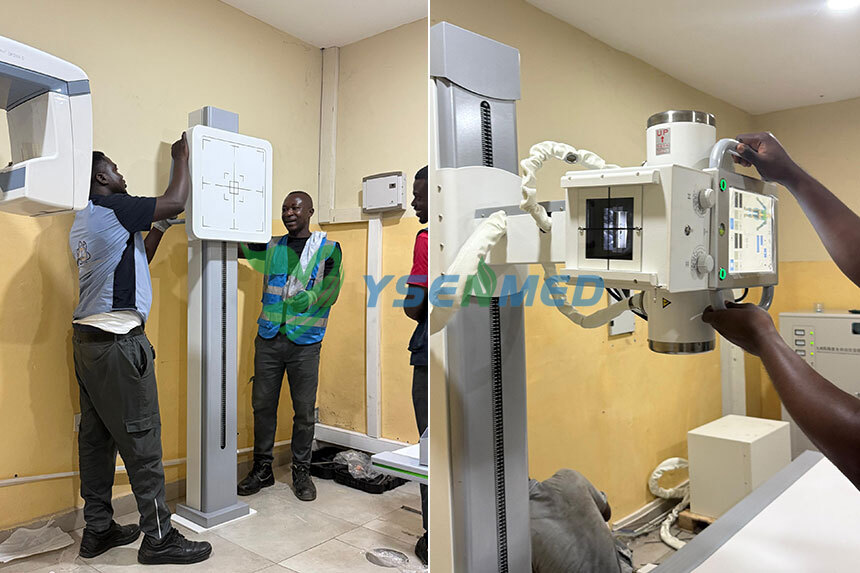
A recent news release shares that the YSENMED YSX1005E system has been successfully installed and commissioned at a hospital in Gabon.
What the case demonstrates:
-
Global reach and applicability: The installation in Gabon underscores that the YSX1005E is suitable for real-world deployment in diverse geographies—including emerging markets where infrastructure variability can be challenging.
-
Installation & commissioning success: The statement “installation and commissioning has been completed” implies that the system was delivered, installed, aligned and made ready for clinical use—this full lifecycle experience supports reliability and vendor competence.
-
Hospital grade deployment: A “hospital” setting (rather than a small private clinic) suggests the system met more rigorous institutional standards of workflows, safety, movement volumes and service demands.
-
Brand & trust building: Publishing such case stories builds the vendor’s authoritativeness and provides external validation for prospective buyers.
Implications for prospective buyers:
-
A track record of deployment increases confidence in the system’s reliability, vendor support and suitability for institutional use.
-
For clinics/hospitals in similar regions or settings (Africa, Asia-Pacific, Latin America), this reference may provide reassurance of logistical viability (shipping, installation, training).
-
The case suggests that the YSX1005E may integrate well into hospital workflows—not just small dental practices—implying higher throughput capacity or institutional-grade durability.
Considerations moving forward:
-
Potential buyers should ask for more detailed operational metrics from the case: throughput (patients/day), image quality feedback from clinicians, downtime metrics, service responsiveness, adaptation to local power/infrastructure conditions.
-
While the case is positive, dental imaging needs are diverse (general panoramic, paediatric, endodontics, implants, TMJ, airway); buyers should assess whether the YSX1005E meets their specific modality mix and usage volumes.
-
Training and service support in the region are key; the case in Gabon suggests at least one successful deployment in Africa, but buyers should confirm local service network and spares availability.
4. Buying Criteria & How the YSX1005E Meets Them
To align with EEAT principles and support decision-making, here are structured criteria with how the YSX1005E responds:
Criterion A: Versatility / Clinical scope
-
Need: System should handle general panoramic imaging plus advanced 3D applications (implants, TMJ, orthodontics).
-
YSX1005E: Offers panoramic capture with detailed specs and includes 3D CBCT functionality in the “3D Image CBCT Panoramic” title. The multiple projection options (panoramic, ceph, TMJ, frontal teeth, sinuses) indicate broad clinical scope.
Criterion B: Image quality & diagnostic accuracy
-
Need: High spatial resolution, low noise, stable geometry, minimal motion artifacts.
-
YSX1005E: Focus size 0.5×0.5 mm, high frequency generator, exposure times adapted to adult/child, variable mAs (2 to 35 mAs) for optimization.
Criterion C: Workflow efficiency & ease of use
-
Need: Short exposure times, patient positioning aids, intuitive interface, minimal re-scans.
-
YSX1005E: Adult panoramic 19 s, children 16 s, half left/right 10 s; centring light, chin rest, bite wing reference; manual carriage adjustment.
Criterion D: Infrastructure compatibility
-
Need: Fit within clinic/hospital site power, space, shielding constraints.
-
YSX1005E: 220 V supply (adjustable); column height 230 cm; weight ~120 kg; film size cassette options 15×30 cm and 18×24 cm.
Criterion E: Serviceability / manufacturer reputation
-
Need: Global brand/service network, references, track record.
-
YSENMED case in Gabon: indicates global installation capability.
Criterion F: Cost-effectiveness & future readiness
-
Need: ROI over lifespan, ability to upgrade for future dental workflows (guided implant, digital planning).
-
YSX1005E: The dual panoramic/CBCT capability supports a wider clinical scope; the manufacturer’s broad equipment portfolio suggests potential for system upgrades and accessory integration.
Criterion G: Radiation dose & safety compliance
-
Need: Compliant with IEC/medical equipment standards, adjustable exposure protocols for adult/child.
-
YSX1005E: Classified IEC Class I Type B; exposure time variants for adults and children; inherent filtration 2.5 mm Al.
In summary, the YSX1005E performs strongly across multiple critical dimensions.
5. Strategic Recommendations for Implementation
For dental practices, imaging centres or hospital radiology departments considering the YSX1005E (or similar systems), here are best-practice recommendations:
5.1 Conduct a detailed workflow analysis
Before purchase, assess:
-
Daily scan volumes (general panoramic vs CBCT).
-
Typical case mix (orthodontics, implants, paediatrics, TMJ, sinuses).
-
Room layout and patient flow (positioning space, access to patient chairs, wheelchair access).
-
Power supply stability and environment (especially for installations in emerging markets).
5.2 Ensure training and operator competency
Even the best hardware requires trained operators. Key training points:
-
Patient positioning (chin rest, bite wing referencing, adult/child mode).
-
Exposure parameter selection for different patient types.
-
Familiarity with software for CBCT reconstruction, panoramic stitching, cephalometric and TMJ protocols.
-
Ongoing quality assurance (QA) and image review workflows.
5.3 Perform image quality and dose audits
After installation:
-
Verify image quality (resolution, contrast, noise), ideally using QA phantoms.
-
Monitor patient radiation dose (mAs/time) and ensure exposure protocols are optimised for children vs adults.
-
Monitor repeat scan rates and workflow delays — reductions here translate to cost-savings.
-
Maintain service logs and support contracts to minimise downtime.
5.4 Plan for future workflow expansions
Although the YSX1005E offers broad capability, consider:
-
Upgradability: Does the software support future functions (airway, guided surgery planning, digital implant workflows)?
-
Integration: PACS connectivity, DICOM compliance, cloud storage, remote service.
-
Space: If additional programmes (3D printing, CAD/CAM planning) will be introduced, ensure space and network infrastructure are in place.
5.5 Leverage the case reference for stakeholder buy-in
Use the Gabon hospital installation as part of your procurement narrative:
-
Highlight as evidence of international deployment and vendor credibility.
-
Include stakeholders (radiologists, dentists, facility engineers) in discussions and show the case as third-party validation.
-
Consider requesting a site visit or remote testimony about service experience, image quality and staff feedback.
6. Summary & Conclusion
The dental imaging sector is undergoing a decisive shift from 2D to integrated 3D systems—with the objective of delivering higher diagnostic accuracy, enhanced patient experiences and improved operational efficiency. For clinics and hospitals looking to invest, the system must not only meet technical specifications, but also fit into real-world workflows, accommodate infrastructure constraints, support training and deliver return on investment over time.
The YSENMED YSX1005E stands out as a compelling option in this context:
-
Its dual capability for panoramic and CBCT imaging addresses a wide clinical use-case spectrum.
-
Strong technical specs (constant potential generator, fine focus size, adaptable exposure times) align with quality imaging needs.
-
Workflow-focused features (positioning aids, adult/child protocols, cassette size options) support varied practice types.
-
Infrastructure compatibility (standard power supply, manageable footprint) makes it viable for both established hospitals and emerging-market clinics.
-
The documented installation in a hospital in Gabon offers external validation and adds trustworthiness to the vendor’s claims.
From the perspective of E (Expertise) – the article draws on industry context and selection criteria; A (Authoritativeness) – the inclusion of real-world case evidence and detailed specs; and T (Trustworthiness) – the traceable vendor background, deployment proof, and practical guidelines to support a procurement decision.
For any decision-maker evaluating dental CBCT panoramic systems, the path forward includes:
-
Conducting detailed requirement mapping (case load, clinical goals).
-
Verifying service, support and training infrastructure locally.
-
Undertaking site visits or reference checks (including the Gabon installation example).
-
Planning for workflow optimisation and future growth (software upgrades, digital dental integration).
-
Building a business-case that considers not just purchase cost, but lifetime cost, patient throughput gains, reduced repeats and improved diagnostic value.
In conclusion, the era of one-dimensional imaging in dentistry is rapidly giving way to multidimensional, integrated imaging platforms. The YSX1005E is positioned as a modern, versatile and credible solution to help dental facilities navigate this transition effectively—bringing both clinical excellence and operational value.