In the rapidly evolving domain of medical imaging, the shift from analog film and computed radiography (CR) to digital radiography (DR) has been transformative. Central to this shift is the rise of the flat-panel detector (FPD) — a core component that delivers enhanced image quality, greater workflow efficiency, and improved patient care. For imaging equipment manufacturers and hospital procurement teams alike, understanding the current landscape of FPDs, the key selection criteria, and how specific solutions perform in real-world settings is critical.
1. Industry Context: Why Flat-Panel Detectors Matter in Digital Radiography
1.1 The market momentum
The global market for X-ray detectors has grown markedly in recent years, driven by the adoption of digital radiographic systems and the benefits they bring. According to the research firm Markets & Markets, the flat-panel detector segment held the largest share of the X-ray detectors market in 2024.
Likewise, data from Fortune Business Insights show that the global X-ray flat panel detectors market was valued at around USD 1.76 billion in 2018 and projected to reach approximately USD 2.8 billion by 2026, growing at a CAGR of about 6%.
These figures highlight the relevance of FPDs in DR systems and the importance of choosing the right detector when designing or upgrading radiography suites.
1.2 Technological trends shaping FPD adoption
Several key trends underpin the growing prominence of FPDs:
-
Improved detector resolution and pixel pitch, enabling finer image detail and better diagnostic confidence.
-
Reduction in radiation dose while maintaining or improving image quality — a vital consideration in clinical settings.
-
Enhanced workflow through digital image capture, immediate availability of images, elimination of film processing, and streamlined PACS integration.
-
Shift from traditional film/CR systems toward DR retrofit and new installations — particularly in emerging markets seeking higher throughput and efficiency.
-
Growing demand for portable or cassette-sized detectors which add flexibility to radiographic operations (e.g., mobile units, emergency imaging).
1.3 Clinical and operational imperatives
From a clinical perspective, the quality of radiographic images directly impacts diagnostic accuracy. Higher resolution detectors allow clinicians to detect subtle findings (e.g., small fractures, early pathology). Operationally, hospitals and imaging centers face pressures to increase patient throughput, reduce repeat scans (often caused by image quality issues), and optimize cost-of-ownership. These imperatives make the choice of detector a strategic decision rather than just a specification.
2. Key Selection Criteria for Flat-Panel Detectors
When evaluating FPDs for a DR system, several critical criteria should guide decision-making. Here are the most relevant:
2.1 Detector size & format
The panel size matters: a 17″ × 17″ format is often the standard for general radiography because it covers the anatomy of most adult examinations and supports high throughput. For cassette-sized wired or wireless detectors, the physical footprint, ease of handling, and system fit are important.
2.2 Pixel pitch (spatial resolution)
Pixel pitch defines how fine the image detail can be. A detector with a 139 µm pixel pitch (for example) will render more detail than a detector with a larger pitch, all else being equal. This matters for high-end DR systems where image clarity is paramount.
2.3 Scintillator type and detector technology
Indirect conversion detectors typically use a scintillator like cesium iodide (CsI) to convert X-rays to light, which is then captured by an amorphous silicon (a-Si) TFT array. Direct conversion detectors (e.g., amorphous selenium) convert X-rays directly to charge. Each technology has trade-offs in sensitivity, noise, cost, and durability.
In market research, CsI-based scanners (within FPDs) held a dominant share because of their high sensitivity and better image quality.
2.4 Workflow integration – tethered vs wireless, cassette-sized vs fixed
Workflow considerations are critical: tethered (wired) detectors offer consistent power/data transfer and may be lower cost, but wireless detectors add flexibility (especially mobile/bedside imaging). Cassette-sized detectors allow portability and adaptability to different tables or mobile units. The detector’s integration with the DR system (software compatibility, automatic exposure detection [AED], DICOM connectivity, PACS workflow) also matters.
2.5 Reliability, durability, and support
In high-volume radiography departments, uptime is paramount. Detectors must be robust, well-supported (service/parts), and have low maintenance. Warranties, manufacturer reputation, and local service network influence total cost of ownership.
2.6 Cost-effectiveness and future-proofing
Beyond purchase price, consider lifecycle cost (maintenance, calibration, upgrades), compatibility with future system enhancements (AI image processing, spectral imaging), and the ability to retrofit into existing systems.
2.7 Regulatory compliance and image quality verification
Ensure the detector meets relevant regulatory standards (e.g., IEC, FDA) and that image quality tests (MTF, DQE) are available to validate performance in your clinical environment. Radiology departments often evaluate fundamental metrics such as detective quantum efficiency (DQE) to compare detector performance.
3. Introducing the YSENMED YSFPD-V1717X
Having looked at industry context and selection criteria, let’s focus on a specific solution: the YSENMED YSFPD-V1717X cassette-sized flat-panel detector.
Model Overview
-
Model: YSFPD-V1717X (17″ × 17″)
-
Brand: YSENMED
-
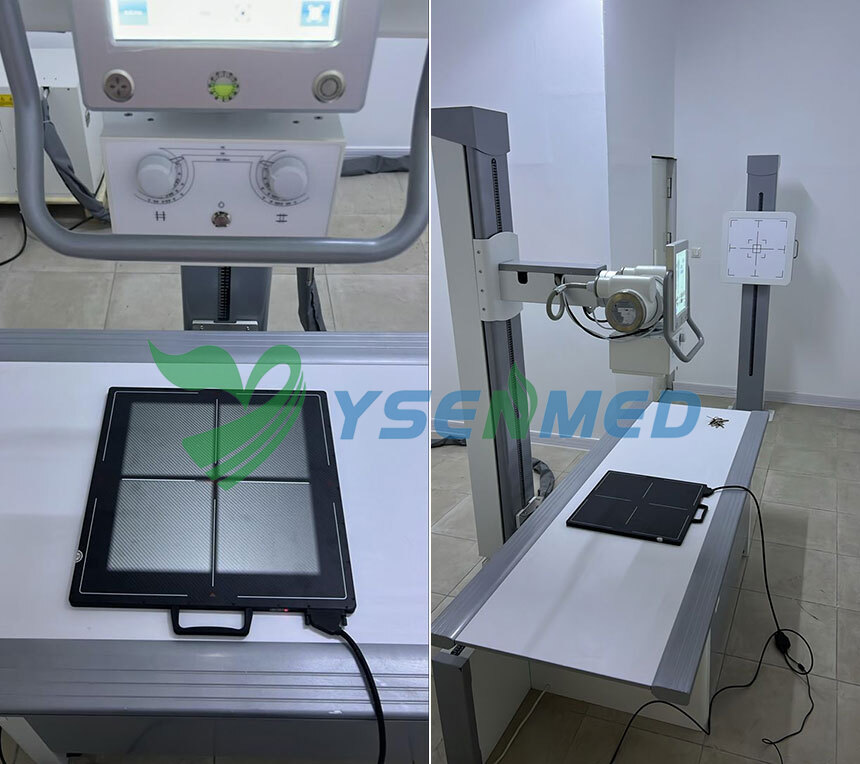
Format: Wired (tethered) cassette-sized flat panel detector.
-
Pixel pitch: 139 µm (indicating fine spatial resolution)
-
Scintillator: Direct deposition CsI (cesium iodide) layer — implying an indirect conversion architecture optimized for sensitivity and image clarity.
-
Workflow: Equipped with a reliable AED (automatic exposure detection) for smart workflow integration.
-
Ideal for: High-end DR systems requiring high image quality and consistent performance.
Why this model stands out
-
The 17″ × 17″ size aligns with standard full-body radiography applications, making it versatile for adult general radiography.
-
A 139 µm pixel pitch supports high resolution, helping detect fine anatomical structures and subtle pathology.
-
The CsI scintillator offers high conversion efficiency, which supports lower dose imaging while maintaining image integrity.
-
The tethered cassette format allows integration into mobile or retrofit DR systems, or as an upgrade path for existing analog/CR suites.
-
The presence of AED simplifies operator workflow and reduces manual steps, which can improve productivity and reduce operator error.
Fit within selection criteria
-
Detector size/format: Meets standard size and supports mobility via cassette format.
-
Pixel pitch/resolution: Very competitive at 139 µm — consistent with high-end imaging demands.
-
Technology: Uses CsI scintillator and a-Si array (inferred), aligning with industry best-practice for indirect FPDs.
-
Workflow integration: Wired connection ensures stable data transfer; cassette format offers flexibility.
-
Reliability/support: Backed by YSENMED’s manufacturing experience and export reach (20 years industry experience) — as stated in your company background.
-
Cost-effectiveness/future-proofing: As part of a global manufacturer’s portfolio, it may benefit from global support and retrofit flexibility.
4. Real-World Validation: Case Study from the Philippines
A critical component of trust and authority is precedent — how the product performs in actual clinical settings. The case of Dr. Jnueva from the Philippines provides such validation.
The scenario
A news article released by YSENMED recounts that Dr. Jnueva “highly approves the image quality” of the YSFPD-V1717X panel detector. medical-x-ray.com Although the case summary is brief, its inclusion underscores the usability and performance of the detector in a real clinical environment.
Key take-aways from the case
-
End-user satisfaction: A practising clinician endorsing the image quality suggests that the detector meets or exceeds clinical expectations.
-
Clinical context: While the exact hospital or exam-type isn’t detailed in the article, the fact that this case originates in a real healthcare environment (Philippines) gives the claim practical weight.
-
Manufacturer credibility: Published case stories build the brand’s authority and serve as reference points for prospective buyers.
Implications for buyers
-
Seeing a validated case provides confidence that the detector is not just a specification on paper but performs in live clinical workflows.
-
For hospital procurement teams, such endorsements contribute to risk-mitigation when deciding on new imaging equipment.
-
The regional context (Philippines) could indicate versatility across diverse healthcare markets — including those in Asia Pacific where many facilities seek cost-effective upgrades.
5. Why the YSFPD-V1717X is a Strategic Choice for DR Upgrades
Putting all the pieces together — industry trends, selection criteria, product features, and real-world case evidence — the YSENMED YSFPD-V1717X emerges as a strategically sound choice for certain use cases. Here’s why:
5.1 Supports transition to digital workflows
Hospitals still relying on analog film or CR systems can significantly benefit from upgrading to a wired cassette-sized FPD like the YSFPD-V1717X. The cassette format eases integration without requiring a fully new table or generator, and the wired interface ensures stable operation in high throughput settings.
5.2 High image quality for diagnostic confidence
In clinical environments where detecting subtle anatomical changes is critical (e.g., orthopaedics, chest radiography, trauma imaging), the 139 µm pixel pitch and CsI scintillator help provide clearer, higher-resolution images. This can reduce repeat scans, improve clinician satisfaction, and ultimately enhance patient outcomes.
5.3 Workflow efficiency and operational performance
The built-in AED feature automates exposure detection, reducing manual steps for radiographers and minimizing the potential for human error. The cassette-sized format also offers flexibility: it can be used in mobile DR units, emergency rooms, retrofit tables, or shared across multiple systems — increasing utilization.
5.4 Cost-effectiveness and support
Given YSENMED’s 20 years in the industry and export to many countries (as your company background indicates), buyers can anticipate a partner with global reach, service capability, and manufacturing expertise. A detector that aligns with standard DR ecosystem sizes (17″ × 17″) has easier compatibility and future upgrade paths.
5.5 Market alignment
As the market for flat-panel detectors continues to grow (CAGR ~ 6% and beyond) and as digital radiography expands globally, investing in a high-quality FPD now positions imaging centres for long-term relevance.
6. Key Considerations and Best Practices for Implementation
While the YSFPD-V1717X offers strong credentials, successful deployment requires attention to implementation details. Below are best practices derived from industry and manufacturing experience:
6.1 System compatibility and calibration
Ensure the DR system (generator, table, processing workstation) supports the detector’s format, pixel pitch, and data interface. Calibration procedures should be verified so that image quality is optimized and consistent over time.
6.2 Workflow training and radiographer proficiency
Adoption of high-resolution detectors often necessitates training for radiographers on proper positioning, exposure techniques, and image post-processing. The improved resolution may reveal more anatomical detail — operator skill becomes even more important.
6.3 Maintenance, service network and longevity
Confirm service availability for the detector in your region, availability of replacement parts (especially for high-volume centres), and warranty terms. Because DR systems are capital investments, total cost of ownership must include maintenance and downtime risks.
6.4 Dose management and image quality monitoring
Even though advanced FPDs support lower dose imaging, ongoing monitoring of radiation dose (e.g., dose area product) and periodic image quality audits (MTF, DQE, uniformity) are recommended to ensure optimal performance and compliance with regulatory guidelines.
6.5 Upgrade path and future technology readiness
Though this detector is wired, estimate the facility’s future needs: wireless detectors, AI-enhanced image processing, spectral imaging capability, or integration with C-arm/fluoroscopy systems. Choosing a detector that can be accommodated within future upgrades can save cost.
7. Concluding Thoughts
In today’s healthcare environment, the quality of radiographic imaging equipment plays a crucial role — influencing diagnostic accuracy, patient throughput, service reliability, and cost efficiency. The flat-panel detector has become a fundamental component of modern DR systems, and selecting the right detector is more than a specification exercise; it’s a strategic investment in performance and future readiness.
The YSENMED YSFPD-V1717X checks many of the boxes: the right size, high resolution, modern scintillator technology, cassette mobility, and real-world clinician endorsement. The case of Dr. Jnueva underscores its practical utility in a clinical environment. Combined with clear market trends that favour digital DR and FPD adoption, this detector represents a sound option for radiology departments, hospital equipment planners, and imaging centre operators seeking to upgrade or expand their DR capabilities.
For a hospital or imaging centre considering a DR upgrade — particularly in regions where cost, workflow flexibility, and image quality are all critical — the YSFPD-V1717X is a compelling choice. It bridges the gap between legacy systems and full next-generation imaging, giving clinicians the resolution and reliability they need while aligning with operational demands.