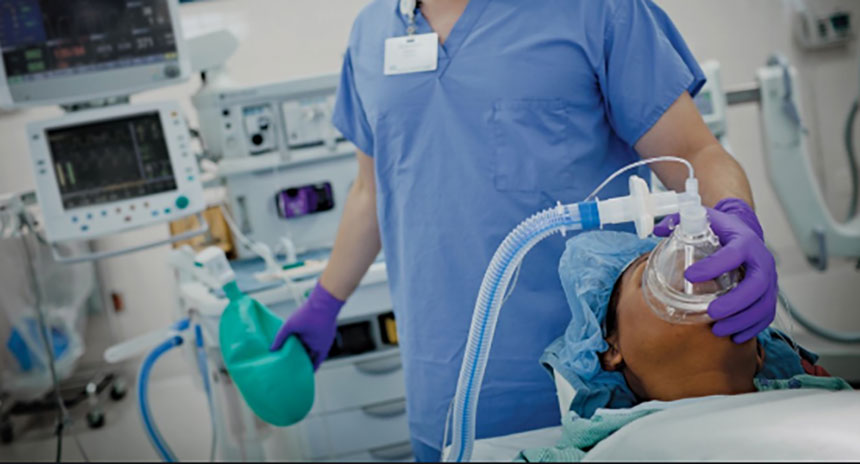
Anesthesiology is a science that studies the elimination of surgical pain, ensures patient safety, and creates good conditions for surgery. Nowadays, anesthesiology has gone far beyond the purpose of simple surgical analgesia. The scope of work is no longer limited to the operating room. It not only includes Anesthesia and analgesia, and involves preparation and treatment during the entire surgical period before and after anesthesia
1. Anesthesia method
Anesthesia classification: a) Local anesthesia b) General anesthesia c) Spinal anesthesia
An ideal general anesthesia must have four elements without seriously interfering with the body's physiological functions: a) complete analgesia b) loss of consciousness c) muscle relaxation d) suppression of nerve reflexes
General anesthesia classification: a) inhalation anesthesia b) intravenous anesthesia c) compound anesthesia
2. Inhalation anesthesia
It is to inhale volatile anesthetic vapor or gas anesthetic into the lungs, enter the systemic circulation through the alveoli, and exert a general anesthetic effect when it reaches the central nervous system.
It is metabolized in the body with little decomposition. Most of it is excreted from the lungs as prototype, and a small amount is excreted through liver and kidney metabolism. Therefore, it is easy to control, relatively safe and effective. It is a commonly used method in clinical anesthesia today, but the cost is high.
3. Intravenous anesthesia
It uses liquid anesthetic drugs to be directly injected into the vein, enters the systemic circulation system through the blood, and exerts a general anesthetic effect when it reaches the central nervous system.
Intravenous anesthetics are mostly excreted from the body through liver and kidney metabolism, and are more decomposed. Since it is injected directly into a vein, it is slightly more difficult to control. However, the cost is relatively low, so it is also a commonly used method in clinical anesthesia today.
4. Compound anesthesia
Combining inhalation anesthesia and intravenous anesthesia, taking the advantages of both and complementing each other, is now the most commonly used anesthesia method.
5. Anesthesia process
The process in which the patient goes from being awake to an anesthetized state in which consciousness disappears is called the induction phase.
The stage in which the patient is kept in a required degree of anesthesia through drugs is called the maintenance stage.
The process in which a patient gradually regains consciousness from an anesthesia state in which consciousness has disappeared is called the recovery stage.
6. Purpose, characteristics and types of anesthesia machines
An anesthesia machine is an advanced medical equipment that can transport a variety of gases and volatile anesthetics, control and assist the patient's breathing, and at the same time adjust the patient's consciousness and pain level during the operation.
7. The function of anesthesia machine
To implement general anesthesia, anesthetic gas (enflurane, isoflurane, sevoflurane or halothane, etc.) is mixed with oxygen and then introduced into the gas circulation system to complete anesthesia.
Provide respiratory management to patients
8. Features of anesthesia machine
The host computer has the necessary alarm system
Equipped with a fully functional all-purpose respirator
Equipped with high-precision anesthetic evaporation tank
Various electronic and mechanical monitors
Usage: semi-open, semi-closed, fully closed
Increased sewage discharge
9. The difference between anesthesia ventilator and therapeutic ventilator
The role of anesthesia ventilator: used to assist or control the patient's breathing during anesthesia and to comprehensively monitor and understand the patient's breathing status
Therapeutic ventilators have higher requirements on the machine itself. In addition to functioning as an anesthesia ventilator, it also requires higher accuracy and more comprehensive functions.
10. Structure and working principle of anesthesia machine
The anesthesia machine mainly consists of: anesthesia host (air supply source), absorption circuit (sodium lime), bellows anesthetic evaporator, anesthesia ventilator, air source flow meter, etc.
11. Air source and air supply system
Gas source: Anesthetic gas should be liquefied gas or compressed gas. Compressed gas is installed in a high-pressure gas storage cylinder or supplied from a central gas supply system
Gas cylinder: It is a sealed container that stores compressed oxygen, carbon dioxide, compressed air and anesthetic gas. The container is made of all-steel that is resistant to physical and chemical factors and high temperature.
Air source pressure gauge: It indicates the input air source pressure of the anesthesia machine
Rapid oxygen supply switch: oxygen supply speed 35 L/min ~ 75 L/min
Common gas outlet: the oxygen and anesthetic drug mixture is connected to the patient absorption circuit through the hose
One-way valve: Located in the gas circuit box, its function is to prevent gas backflow
Air control alarm device: When the oxygen pressure is insufficient, a sound alarm will sound for more than 7 seconds; it consists of a gas storage tank, a reversing valve, and a steam whistle.
Nitrous oxide cut-off device: When the oxygen supply is insufficient, the laughing gas cut-off valve is closed to prevent the laughing gas from entering the anesthesia machine air circuit.
Flowmeter: It is a tool for measuring the flow of flowing gas. It can accurately control the gas flow after decompression of the gas source. It is one of the important components of the anesthesia machine.
Series flow meter: double tube (0~1L/min, 1~10L/min
General flow range:
Oxygen: 0 L/min~10 L/min
Laughing gas: 0 L/min~10 L/min
Air: 0 L/min~10 L/min
Oxygen laugh linkage function: ensure oxygen output is greater than 25%
12. Absorber
Utilize absorbents to effectively absorb CO2 exhaled by patients in the circulation circuit
Function: stores anesthetic gas and oxygen, discharges waste gas as needed, and absorbs CO2. It is directly connected to the respiratory tract and assists in completing the breathing process.
Structure and composition:
a) APL valve b) Inhalation valve c) Expiration valve
d) Machine control/manual transfer switch
e) Airway pressure gauge f) CO2 absorber
Bellow
The driving gas acts on the foldable sac to press the mixture of anesthetic gas and oxygen into the patient's lungs.
There are exhalation rising bellows and exhalation descending bellows
The exhalation rising bellows makes it easy to observe circuit leakage.
The expiratory descending bellows is not easy to perform low-flow anesthesia and is prone to produce end-tidal negative pressure.
Evaporator
A device that converts liquid volatile inhalation anesthetics into vapor and feeds it into the anesthesia circuit in a certain amount
Its functions are:
a) Efficiently evaporate volatile inhaled anesthetics;
b) Precisely control the output concentration of volatile anesthetic drugs
The anesthesia evaporator is an important part of the anesthesia machine. Its quality not only marks the level of the anesthesia machine, but is also related to the success or failure of inhalation anesthesia and directly involves the safety of the patient.
The emergence of anesthesia machines will not only improve the quality of surgery, but also play a huge role in the medical field, bringing more possibilities for patient treatment and recovery.